
DS-C80N-01HI/4K
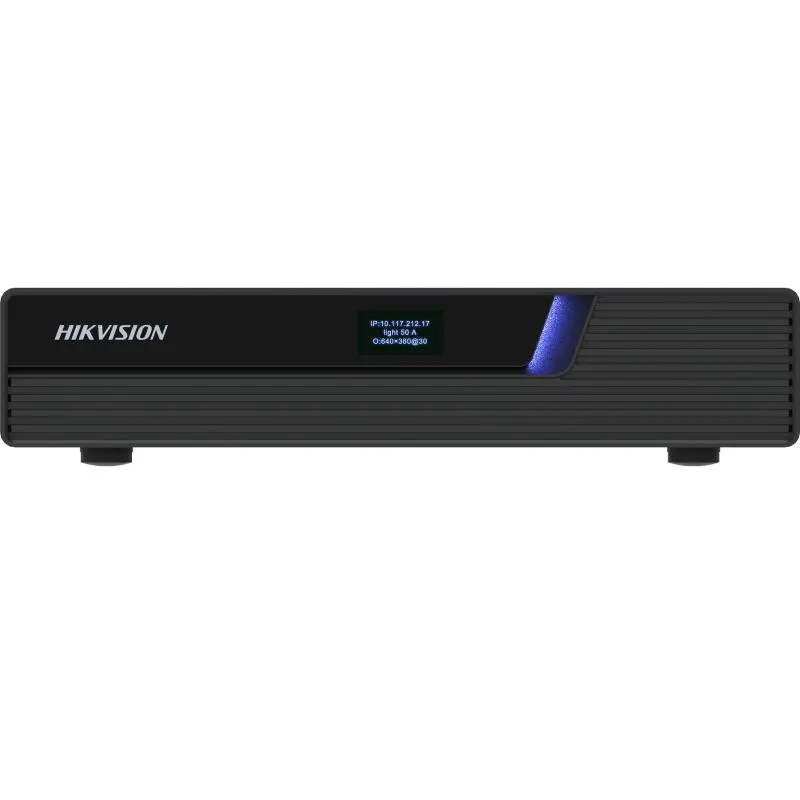
Hikvision DS-C80N-01HI/4K Distributed 4K HDMI Input Node
The Hikvision DS-C80N-01HI/4K is a distributed input node that takes one 4K60 HDMI 2.0 source and sends it across the network to a video wall. It has an HDMI loop-out, dual-channel 24-bit audio, a 1000 Mbps SFP and Ethernet pair with hot backup, and PoE 802.3at support. Each node works independently, with no central server. It suits command rooms, control centres and campus AV teams in Qatar building flexible walls.
What this input node does in a distributed wall
The DS-C80N-01HI/4K is an input node in Hikvision's distributed video wall system. It accepts one 4K60 HDMI 2.0 source, such as a presentation PC, media player or camera feed, and sends the picture over the network to output nodes that drive the screens. Because the signal travels as network traffic, the source can sit in a different room, floor or building from the wall.
Each node operates independently and the system has no central server. If one node fails, the rest of the wall keeps running, which suits control rooms and command centres where a single fault should not blank the whole display.
Specifications that shape the design
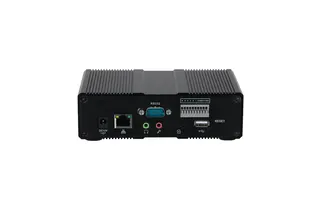
- Video: one HDMI 2.0 input up to 4K at 60 fps, a loop-out HDMI 2.0 port for passing the signal on, and YUV 4:4:4 sampling.
- Audio: 3.5 mm audio input and output, dual channel, 24-bit at 48 kHz.
- Network: one 1000 Mbps SFP port and one 1000 Mbps Ethernet port, with hot backup between them.
- Power: 802.3at PoE, or an external supply for a dual power arrangement. Consumption is 30 W or less.
- Control: RS-232, RS-485, configurable IO/IR inputs and outputs, a relay and a 3.3 V IR power terminal.
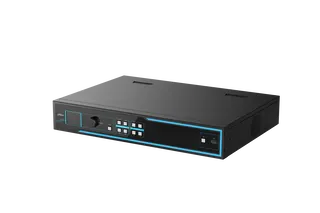
- Size: half-width, so two nodes fill one rack width, with a 128 × 64 OLED status screen on each unit.
Where it fits in Qatar
A government operations room in Doha might route feeds from several floors to a wall of screens. Each source gets its own input node in a comms cabinet, and output nodes drive the displays in the room. Because the node accepts network signals as well as HDMI, cameras and NVRs already on the building network can join the wall, with ONVIF support for device access.
In Education City, a university might link a lecture hall with a studio or a partner campus. The 1000 Mbps links and compression that adapts to network quality help keep images clear when bandwidth varies between buildings. An industrial site in Mesaieed or Ras Laffan could place the nodes in a control room while the sources stay in a plant building, using the RS-485 and relay interfaces to connect local equipment.
What to plan before ordering
Check the cabinet temperature first. The rated working range is 0 °C to 50 °C with 0% to 95% humidity. Summer temperatures in Qatar exceed 45 °C, so nodes should sit in an air-conditioned comms room or a ventilated cabinet, not a hot corner of a shared space. Hot backup and separate power help, but cooling is the first thing to confirm.
Count the sources and screens before quoting. Each node handles one HDMI input, and the rack needs room for two nodes per rack width. The power cord, mounting bracket and connecting bracket come in the box. Plan switch ports and the PoE budget if you use 802.3at, or a 110 to 240 VAC supply where PoE is not used. Qatar mains is 240 V, which falls within that range. SmartRooms Qatar offers free site surveys, and we recommend one before a multi-node installation to confirm cabling and cabinet space.
To request a quote for the DS-C80N-01HI/4K, tell us how many sources and screens you need and where the cabinets will sit. Quotations are usually issued within one working day, and we can work from a purchase order, an LPO or a government tender.
Highlights
- One 4K60 HDMI 2.0 input with HDMI loop-out
- YUV 4:4:4 image sampling for accurate colour
- 1000 Mbps SFP and Ethernet ports with hot backup
- 802.3at PoE or external dual power supply
- Half-width design: two nodes fit one rack width
- Working range 0 °C to 50 °C, 0% to 95% humidity
Estimated timeline
Quotation within 1 working day · delivery timing depends on stock availability, and we confirm it with your quotation.
Specifications
Device Feature4
- Device Type
- Input node
- KVM Function
- No
- Signal Source Live View
- Supported
- Dual Device Hot Backup
- Supported, customized
Interface12
- Optical Interface
- 1 channel of 1000 Mbps SFP port
- Electrical Interface
- 1 channel of 1000 Mbps Ethernet port
- USB Interface
- 1 × USB 2.0 port
- Screen Type
- OLED 128 × 64 dot-matrix screen
- Other Interfaces
- 1 × Console port for debugging
- RS-232 Interface
- 1 channel, Phoenix terminal
- RS-485 Interface
- 1 channel, Phoenix terminal
- IO/IR IN Interface
- 1 channel, Phoenix terminal, customized by software
- IO/IR OUT Interface
- 1 channel, Phoenix terminal, customized by software
- IR POWER Interface
- 1 channel, 3.3 V, Phoenix terminal
- RELAY Interface
- 1 channel, Phoenix terminal
- RESET Interface
- 1 channel
General10
- Working Temperature
- 0 °C to 50 °C
- Working Humidity
- 0% to 95%
- Indicator
- 1 × single double base color light indicator, 1 × optical port indicator, 1 × network port indicator
- Net Weight
- 1.27 kg (2.80 lb.)
- Gross Weight
- 1.62 kg (3.57 lb.)
- Dimensions (W × H × D)
- 210 mm × 42 mm × 180 mm ( 8.27 inch × 1.65 inch × 7.09 inch)
- Installation Method
- Magnetic installation (optional), planar arrangement, rack installation
- Packing List
- 1 × DS-C80N-01HI/4K,1 × regulatory compliance and safety information manual, 1 × power cord, 1 × mounting bracket, 1 × connecting bracket
- Power Consumption
- ≤ 30 W
- Power Supply
- Power supply: 110 VAC to 240 VAC, 0.7 A POE: 802.3at protocol
Video6
- Video Input Interface Type
- HDMI 2.0
- Video Input Interfaces
- 1
- Max. Video Input Resolution
- 4K60
- Image Sampling
- YUV 444
- Loop Output Interface
- 1 channel of HDMI 2.0
- Video Input Resolution
- 1024 × 768@60 Hz, 1280 × 1024@60 Hz, 1360 × 768@60 Hz, 1440 × 900@60 Hz, 1280 × 960@60 Hz, 1600 × 1200@60 Hz, 1280 × 720p@60 Hz, 1920 × 1080p@60 Hz, 1920 × 1200@60 Hz, 3840 × 2160@30 Hz, 3840 × 2160@60 Hz, 4096 × 2160@30 Hz, 4096 × 2160@60 Hz, custom resolution in the range of 1920 × 1080 to 4092 × 2160
Audio7
- Audio Input Interfaces
- 1
- Audio Input Interface Type
- 3.5 mm coaxial audio jack
- Audio Channel
- Dual audio channel
- Audio Output Interfaces
- 1
- Audio Output Interface Type
- 3.5 mm coaxial audio jack
- Audio Talk
- Use the audio input port and audio output port
- Audio Sampling Rate
- 24 bit, 48 KHz
Video Encoding7
- Video Encoding Format
- H.265 (default), H.264
- Video Encoding Channels
- 1
- Video Encoding Capability
- Sub-stream and main stream encoding; Sub-stream encoding contains: CIF(352 × 288), FCIF(704 × 576), 720p(1280 × 720) Main stream encoding contains: 720p(1280 × 720), XGA(1024 × 768), XVGA(1280 × 960), SXGA(1280 × 1024), WXGA(1360 × 768), WSXGA(1440 × 900), UXGA(1600 × 1200), 1080p(1920 × 1080), 1920 × 1200, 3840 × 2160, 4096 × 2160, custom resolution in the range of 1920 × 1080 to 4092 × 2160
- Input Logo Overlay
- Not supported
- Input OSD
- Supported, 2 OSDs
- Input Image Clipping
- Supported, clipping value range at the top, bottom, left and right: 0 to 200 pixels
- Live View Channels
- 6 simultaneous channels
Audio Encoding2
- Audio Encoding Format
- G711A, G711U, G722.1, AAC_LC
- Audio Encoding Channels
- 1